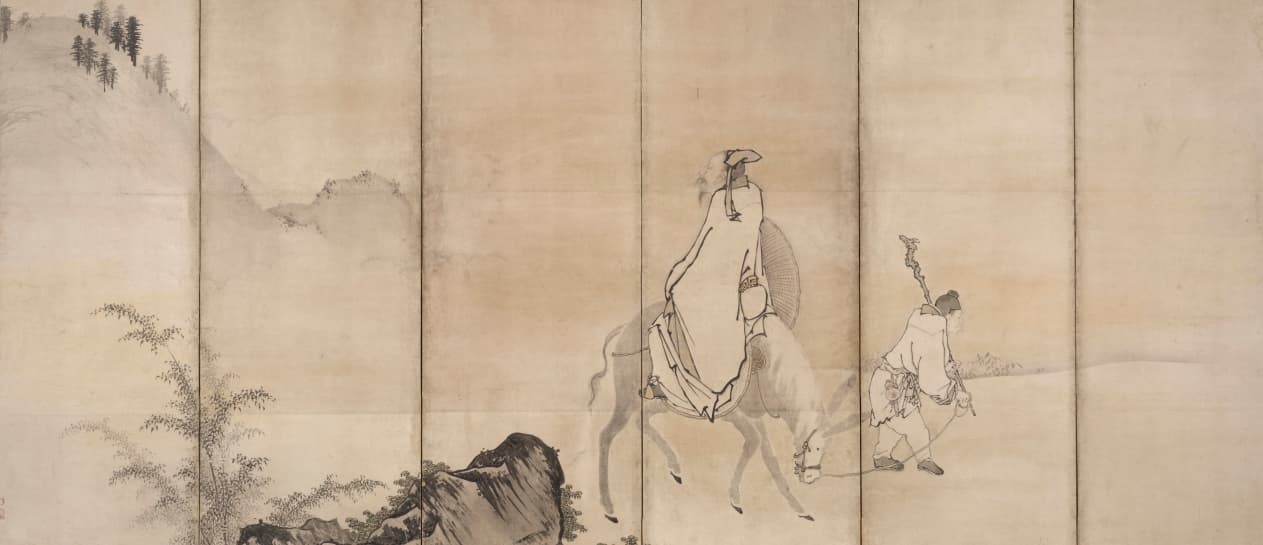
Painting study · Ink painting
Pan Lang (Han Rō)early 1600s · Study 2006.135.2
Unkoku Tōgan (Japanese, 1547–1618)
early 1600s
Recorded as one of a pair of six-panel folding screens; ink, light color, and gold on paper, this horizontal work measures 360 × 155.5 cm using the museum’s image dimensions. Explore the museum’s context and compare the format with a wall of your choice.
Museum collection reference. This work is not offered for sale by Physical Art For Crypto. Museum attribution does not imply a partnership or endorsement.
Context from the museum
This is one of the pair of screens depicts episodes from the stories of famed Song-dynasty poets Su Shi of the 1000s and Zhou-dynasty official Pan Lang of the 900s. Both men were banished by their rulers for their perceived missteps. Su Shi’s comments on a series of economic reforms were seen as criticism of the emperor. Pan Lang composed an ill-advised verse about one of the king’s horses. In this screen Pan rides backward on his donkey as he returns from exile so that he may have a last look at his now beloved Mount Hua. Su Shi, on the other screen, is shown embarking on his journey into exile. The artist of these screens, Unkoku Tōgan, was the founder of the Unkoku school of painting, which emulated the style of renowned ink painter Sesshū Tōyō (1420–1506). Tōgan was the official painter of the Mori family of what is now Yamaguchi prefecture in the south of Japan.
Museum description reproduced from its CC0 open-access record. Read the original catalog entry.
Read the dimensions before the image
The selected image measurement for Pan Lang (Han Rō) is 360 cm wide and 155.5 cm high, equivalent to approximately 141.7 × 61.2 inches. Dividing width by height gives a format ratio of 2.32:1. The rectangular bounding area is 5.60 square meters; it describes the measured footprint, not the amount of paint or the monetary value.
On an illustrative 300 cm wall, the recorded width occupies 120.0% of the span before adding a frame. That exceeds the example wall width, so a smaller reference wall would not reproduce the recorded scale. These are calculations by Physical Art For Crypto using museum measurements. They are not the museum’s display recommendations.
Questions to bring to your own collection
With Pan Lang (Han Rō) in view, identify one feature you can point to, then distinguish what the museum records from your personal response. Keep its medium, one of a pair of six-panel folding screens; ink, light color, and gold on paper, in your notes when comparing contemporary works.
- Which part of this horizontal composition catches your eye first?
- Would a 360 cm width still suit the space after allowing for furniture and a frame?
- What surface detail would you need to see in person or in a close photograph?
Explore physical scale
How large would this format feel on your wall?
Use this museum work’s recorded format as a reference. Adjust a blank wall and optional frame allowance to compare proportions. The museum painting is an educational reference and is not for sale here.
Calculation: outside width = recorded width + twice your frame allowance. This is a proportion study, not an installation assessment. It excludes furniture, hardware, load capacity, depth and delivery clearance. The display image may include margins absent from the recorded measurement.
Compare formats with the studio collection
These Lei-Kol works have the closest width-to-height ratios in the current catalog. This is a geometry comparison, not a claim of artistic similarity, equivalent value, or association with the museum artist.
| Painting | Width × height | Format ratio | USD catalog price |
|---|---|---|---|
| Bipolar | 60 × 48 in | 1.25:1 | $3,499 |
| Brick and Mortar | 60 × 48 in | 1.25:1 | $3,499 |
| Dominion | 60 × 48 in | 1.25:1 | $3,499 |
Availability and delivery costs must be confirmed for the individual order.
Related studies
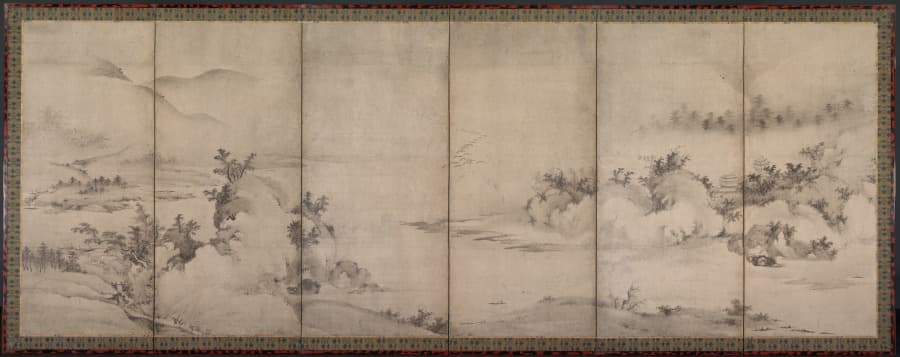
late 1500s–early 1600s · Japan, Momoyama period (1573–1615)
Landscape with Motifs from the Eight Views of Xiao-Xiang
Artist not recorded · One of a pair of six-panel folding screens; ink on paper
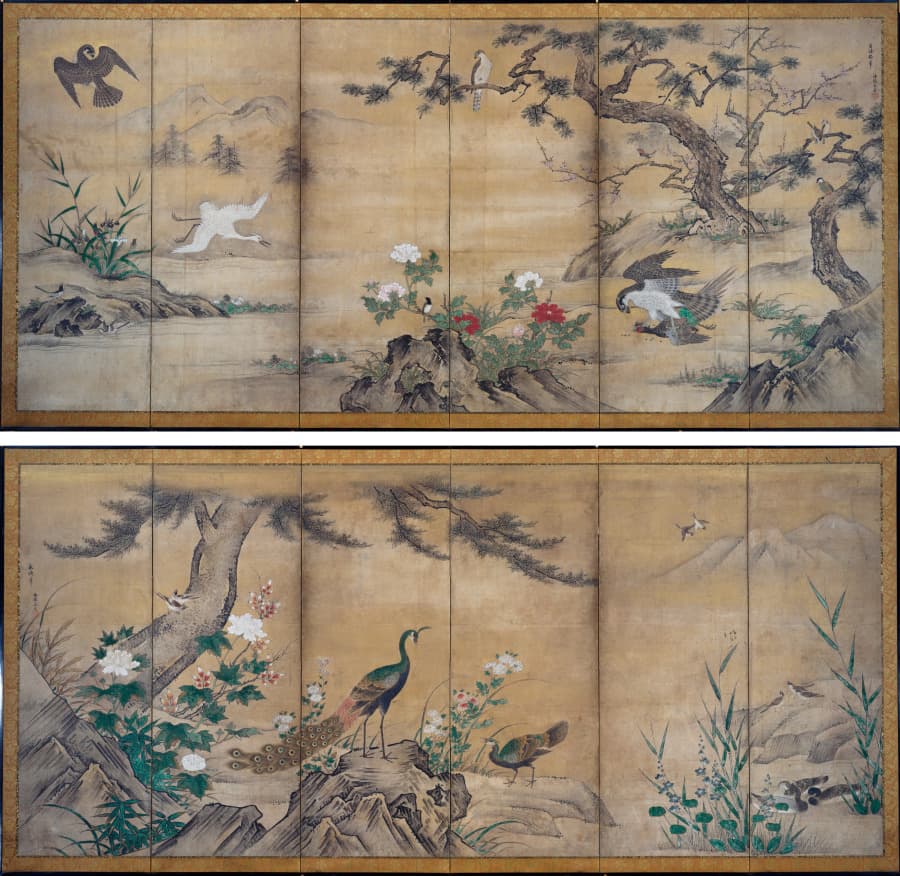
late 1500s · Japan, Momoyama period (1573–1615)
Birds and Flowers
Kano Mitsunobu (Japanese, 1565–1608); Kano Shōei (Japanese, 1519–1592) · Pair of six-panel folding screens; ink, color, and gold on paper
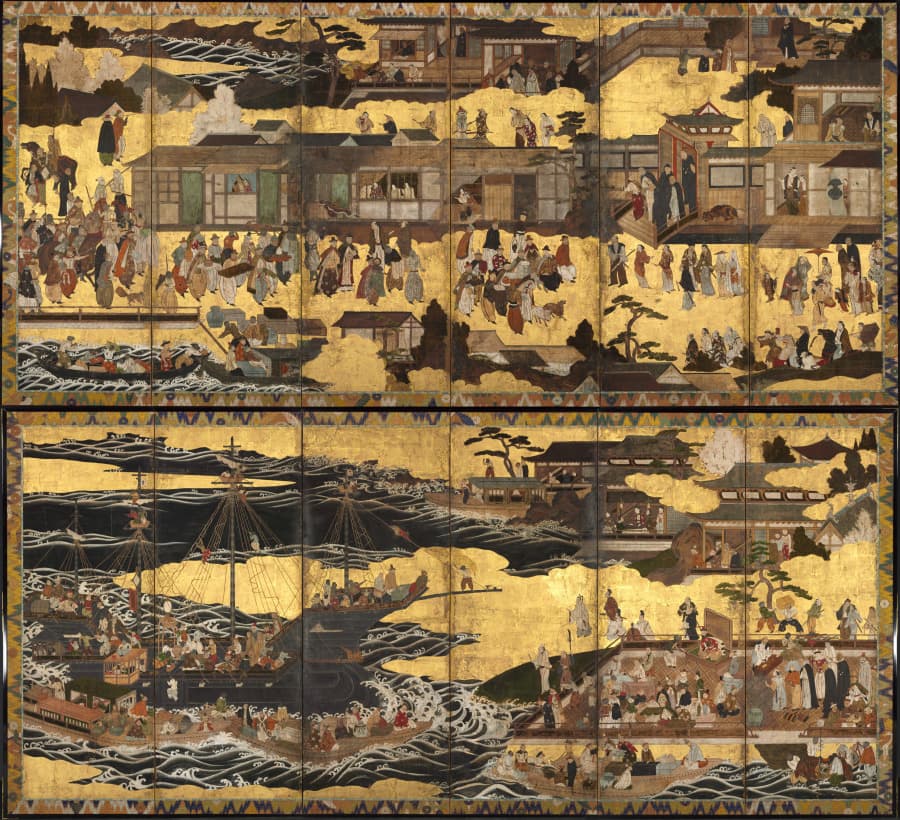
c. 1600 · Japan, Momoyama period (1573–1615)
Arrival of the "Southern Barbarians"
Artist not recorded · Pair of six-panel folding screens; ink, color, and gold on paper
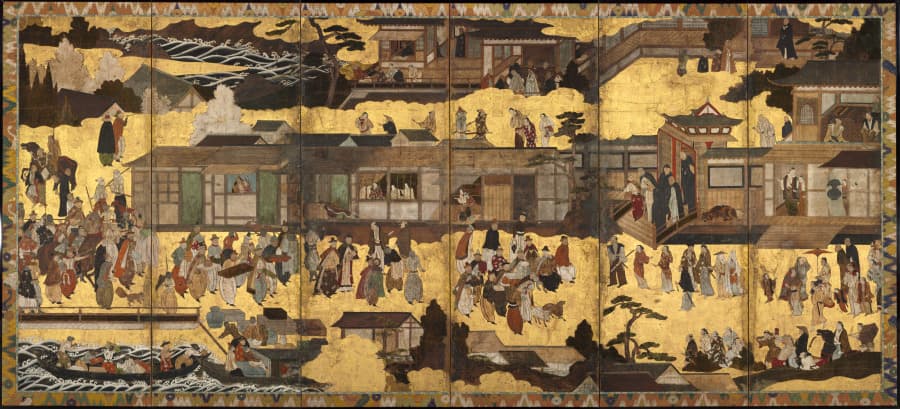
c. 1600 · Japan, Momoyama period (1573–1615)
Arrival of the "Southern Barbarians"
Artist not recorded · One of a pair of six-panel folding screens; ink, color, and gold on paper
Ready to describe what you want in your own space?
Start an artwork inquiry ↗