Collector Strategy
Art as an Investment
Understanding the Value of Original Paintings
Art is not a stock. It pays no dividend, generates no cash flow, and its value cannot be calculated from a spreadsheet. But for those who understand how art markets work — and buy carefully — original paintings can be among the most rewarding assets you will ever own, both financially and personally.
Why Original Art Holds Value
Unlike most consumer goods, which depreciate the moment you unbox them, original art has no built-in depreciation curve. A painting does not wear out like a car. It does not go out of style like last season's furniture. It does not become obsolete like a smartphone. A well-made acrylic on canvas, properly cared for, will look exactly the same in fifty years as it does today. Its value path is determined by things the painting has no control over: the artist's career trajectory, market demand, critical recognition, exhibition history, and the simple passage of time.
Scarcity is the foundation of all art value. An original painting is one of one. When it sells, no other version of it exists — no edition, no print run, no replica. This is fundamentally different from almost every other asset class. Stocks are fungible. Bitcoin is fungible. Real estate is location-scarce but not object-scarce — another house can be built on the lot next door. Original art is the only major asset class where the supply of any given work is exactly one, permanently. This is not a nuance. It is the central economic fact of the art market.
Beyond scarcity, art carries cultural value — a component no financial model can price. A painting that captures a moment in an artist's development, a piece that becomes associated with a particular movement or era, a work that is exhibited in a significant show — all of these contextual factors can multiply value far beyond what the paint and canvas are worth. The art market rewards stories, and original paintings are the physical containers of stories.
Primary vs. Secondary Market
The art world operates across two distinct markets, and understanding the difference is essential for any collector thinking about value. The primary market is where art is sold for the first time — directly from the artist or through a representing gallery. Every Lei-Kol catalog painting and commission is a primary market transaction. The price is set by the artist (or gallery) and reflects current market positioning. Primary market prices for emerging and mid-career artists are typically the lowest prices those works will ever be available at — the so-called ground floor.
The secondary market is where art is resold — through auction houses, private dealers, or collector-to-collector sales. Secondary prices are set by supply and demand. A painting that sold for $2,000 on the primary market might resell for $5,000 if the artist has gained recognition, $500 if demand evaporated, or $50,000 if the artist has become famous. The secondary market is where art investment returns are realized. It is also where the risks surface — art is illiquid, resale is not guaranteed, and timing matters enormously.
Most art investors never participate in the auction-house tier of the secondary market. That world — Sotheby's, Christie's, Phillips — is for established artists with proven auction histories. For emerging artists like Lei-Kol, the secondary market exists primarily through private sales and direct collector networks. A collector who bought Maui when it was first listed and sold it five years later to another collector through a private transaction has realized a secondary-market return without an auction house ever touching the piece. This private secondary market is real, it is active, and it is where most returns are generated for emerging-artist work.
Factors That Affect Art Value
Size matters. Larger works by the same artist typically command higher prices on both primary and secondary markets — and they tend to appreciate more in absolute dollar terms. A 48x60-inch statement piece is inherently more significant than a 24x30-inch work. This is not a snobbery about scale; it is a reflection of the artist's investment of time, materials, and creative energy. Large paintings are harder to make, harder to transport, harder to display — and therefore rarer.
Period matters. Early works from an artist's career often carry a premium once the artist is established, because they represent the genesis of the style the artist became known for. Mid-career works from an artist at peak technical mastery represent the most accomplished examples of the mature style. Late-career works carry the weight of a lifetime's experience. For a working artist like Lei-Kol, who is actively building her career and catalog, current-period works sit at the intersection of accessible pricing and long-term appreciation potential.
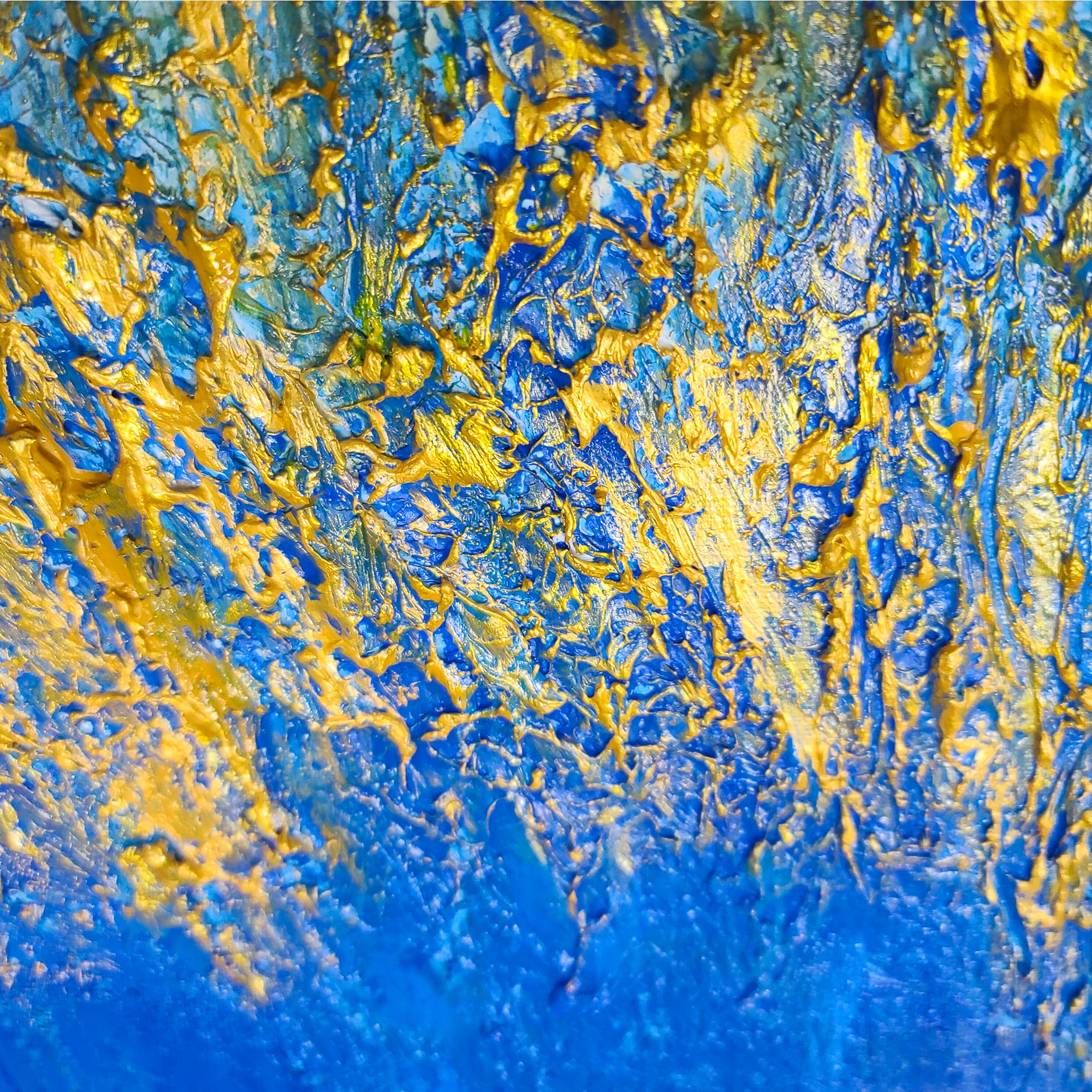
Subject and technique matter. An artist's most characteristic work — the pieces that define their visual signature — tends to appreciate more than outlier experiments. For Lei-Kol, heavy impasto abstracts with rich, saturated palettes are the signature. A flat, subdued experiment might be interesting, but the market rewards the work the artist is known for. Technique also functions as an anti-forgery feature: heavy impasto is extremely difficult to convincingly reproduce, which makes Lei-Kol originals easier to authenticate and harder to fake — a nontrivial factor in sustained value.
Exhibition history matters. Paintings that have been publicly exhibited — in solo shows, group shows, juried exhibitions, or art fairs — carry additional provenance weight. Exhibition catalogs, press mentions, and third-party recognition all build the narrative around a piece. If a collector is evaluating two otherwise similar paintings, the one with exhibition history will command a higher price. Lei-Kol's exhibition history is growing, and collectors who acquire works that later appear in significant shows benefit from the appreciation that follows.
Provenance and Documentation
Provenance is the documented chain of ownership from the artist to the current owner. It is the art world's equivalent of a car's title history — and it is absolutely critical to value. A painting with clear, complete provenance will always sell for more than an identical painting with gaps or uncertainty in its ownership history. Provenance proves authenticity, establishes legal ownership, and demonstrates that the work was not looted, stolen, or forged.
For Lei-Kol originals, the provenance package is strong from day one. Every painting ships with a signed Certificate of Authenticity that references the specific work by title, dimensions, medium, and creation date. A photo record of the painting in the studio, in progress, and at completion provides visual provenance that no forgery can match. And for crypto buyers, the on-chain transaction record creates a permanent, timestamped, unalterable proof of purchase that ties your wallet to the specific acquisition. Combined — certificate plus blockchain record — this is provenance architecture that most emerging artists do not provide and most established ones are only beginning to consider.
If you ever resell a Lei-Kol original, pass the certificate and all documentation to the next owner. Suggest they do the same. Provenance strengthens with every documented transfer. A painting that changes hands three times with complete records is worth more than one that changes hands once with no records at all — it has a verifiable market history.
Tax Considerations for Art Collectors
Art is subject to capital gains tax when sold at a profit, just like stocks or real estate. In the United States, art held for more than one year is taxed at the collectibles capital gains rate of 28% — higher than the long-term capital gains rate for securities (typically 15–20%), but lower than the top ordinary income rate (37%). Art held for less than one year is taxed as ordinary income. The holding period starts from the date of purchase. Your purchase receipt — whether in dollars or in cryptocurrency converted to dollar value at the time of transaction — establishes your cost basis.
Donating art to a qualified nonprofit (museum, university, charitable foundation) can generate a tax deduction equal to the fair market value of the work, provided the donation is related to the organization's mission — meaning you donate a painting to an art museum, not to a food bank. For donations valued above $5,000, the IRS requires a qualified appraisal. For donations above $50,000, the IRS may review the appraisal independently. This is a well-established path for collectors who want to realize value from their collection while supporting institutions they believe in.
Art held until death receives a stepped-up basis for heirs — meaning your beneficiaries inherit the painting at its current fair market value, not your original purchase price. If they sell it, they owe capital gains only on appreciation after your death. This is the same stepped-up basis rule that applies to securities and real estate, and it makes art an effective vehicle for intergenerational wealth transfer. Estate tax applies to art just like any other asset — the fair market value of your collection is included in your taxable estate. Proper appraisal and documentation are essential for estate planning.
None of this constitutes tax advice. Tax laws vary by jurisdiction and change over time. Consult a qualified tax professional before making decisions about art donation, sale, or estate planning. The point is not to give you a tax strategy but to make you aware that art carries tax implications — and that informed collectors plan for them.
Crypto and Art Investment
Cryptocurrency and physical art intersect in a way that benefits both asset classes. Crypto holders are, by definition, comfortable with alternative assets, value sovereignty, and store-of-value thinking. They understand that not everything needs to be in a brokerage account. Original art is a natural diversification for a crypto-heavy portfolio — an asset class that is uncorrelated with cryptocurrency markets, physically tangible, and culturally significant in a way digital assets alone cannot be.
Using cryptocurrency to purchase art also creates a clean, borderless transaction path. No bank holds, no currency conversion fees, no international wire transfer delays. A buyer in Singapore can send ETH to the artist in Arizona and receive the painting in Singapore — all without a single traditional financial institution touching the transaction. The blockchain records the purchase permanently, providing a timestamped proof of provenance that no paper receipt can match. For art investors who think globally, crypto payment is not a gimmick — it is the most efficient settlement rail available.
That said, volatility cuts both ways. If you buy a painting for 1 ETH when ETH is $3,000, and ETH rises to $4,000 before the artist converts to dollars, your purchase effectively cost more in dollar terms. Conversely, if ETH drops, your purchase cost less. Crypto-native collectors understand this and factor it into their decisions. For those who prefer price certainty, PayPal is always available — and many collectors use a mix: crypto for the philosophical alignment, PayPal for the pieces where dollar-denominated accounting matters.
The Most Important Rule of Art Investment
Buy art you love. Buy it because you want to live with it, because it moves you, because looking at it every day makes your life better. If it appreciates in value — and original art by working artists with growing reputations often does — that is a bonus. If it does not, you still own a painting that makes your wall more interesting than your neighbor's. No stock certificate ever did that. Art investment done right means you win either way.
Discuss Your Collection
Ask Us About Investment-Grade Work
Explore Related
Related Collector Resources
Original Art Price Guide
What Lei-Kol originals cost at each size tier — transparent, direct-from-artist pricing.
Certificate of Authenticity
How provenance documentation protects your investment and supports future resale.
Art Care & Maintenance
Keep your investment in museum-grade condition for decades.
Building an Art Collection
A complete guide to starting and growing a collection of original art.
Original Art vs Prints
Why originals hold value and prints depreciate — the investment perspective.
How Buying Art with Crypto Works
Complete guide to purchasing fine art with Bitcoin, Ethereum, and other cryptocurrencies.