Illumination
How to Light Artwork
A Complete Guide for Paintings
Light is the fourth dimension of a painting. It can reveal texture you did not know was there, make colors vibrate, or wash everything flat. A well-lit painting anchors a room. A poorly lit one goes unseen. This guide covers everything from color temperature to fixture selection for original art.
Why Lighting Transforms Art
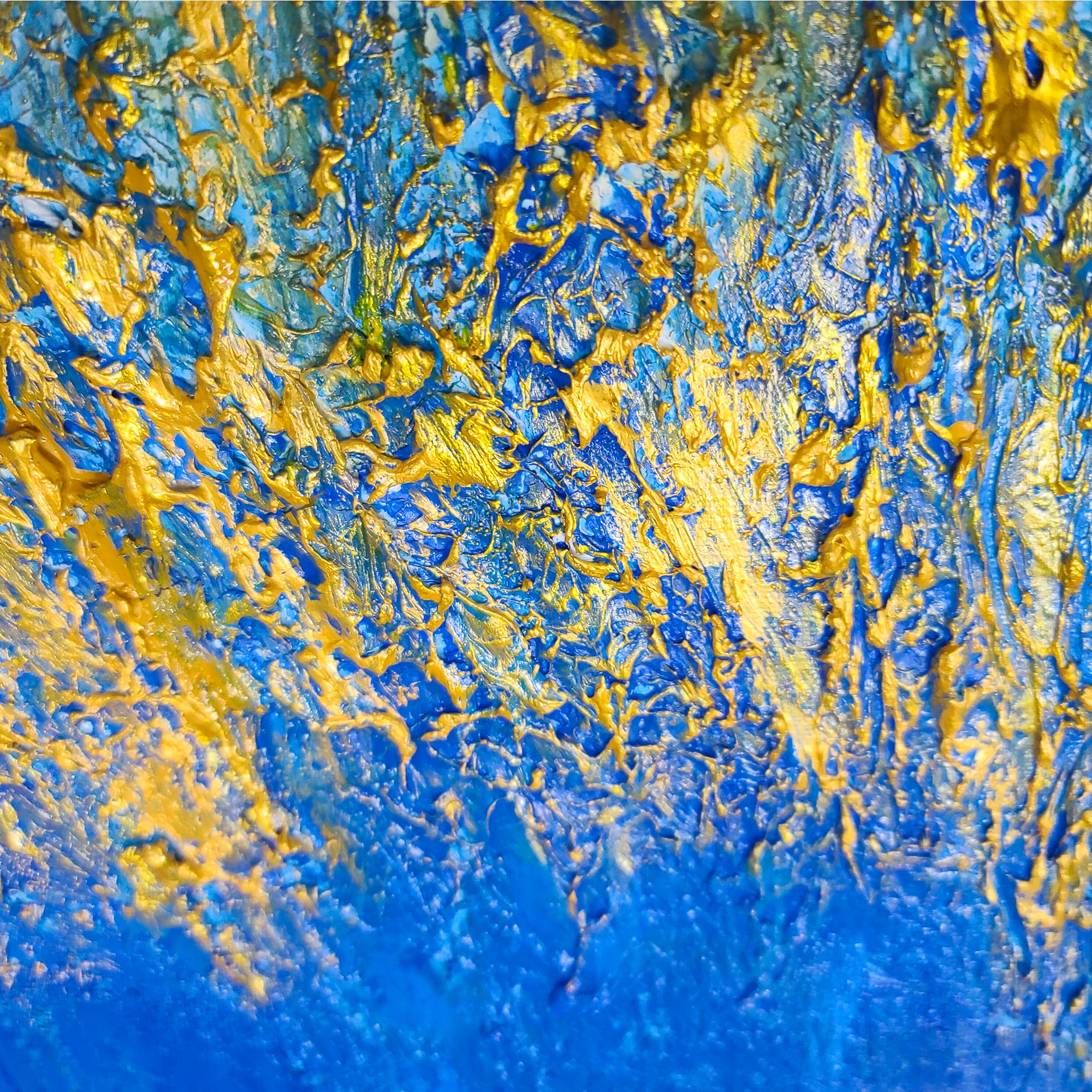
The same painting under different light is effectively a different painting. Raking light from a low angle picks up every ridge and peak of impasto texture, creating dramatic shadow-play that changes throughout the day. Flat overhead light eliminates texture — the painting becomes a flat image rather than a dimensional object. Warm light (2700K) brings out golds, reds, and earth tones, making cool blues recede. Cool light (4000K+) brings out blues and greens while muting warm tones. The difference between a painting that “looks nice” and one that stops people in their tracks is often not the painting itself — it is the light hitting it.
For heavy-texture paintings like Lei-Kol originals, lighting is not decorative — it is essential. The centimeter-deep ridges and sculptural peaks of impasto work are designed to catch light and cast shadow. If the light source is diffuse and overhead — a standard ceiling fixture with a frosted bulb — the texture flattens, the shadow disappears, and half of what you paid for becomes invisible. If the light is directional and angled — a picture light, a track head, a dedicated wall washer — the texture performs. This is not a subtle difference. It is the difference between a painting that commands the room and one that blends into the wall.
Natural Light vs. Artificial Light
Natural daylight is the reference standard for viewing art — it is what painters paint under and what galleries aspire to approximate. Daylight is full-spectrum, meaning it contains all visible wavelengths equally, rendering color with maximum accuracy. The catch is that natural light is inconsistent and, in its direct form, destructive. A painting that catches direct morning sun may look spectacular for thirty minutes and then begin fading. A painting in a north-facing room with consistent indirect light will look good all day without sustaining UV damage. The ideal natural-light scenario for art is bright indirect daylight — a room with large windows that face north or are shaded by trees, overhangs, or sheer curtains. South-facing windows without UV film are a threat to art and should not be counted as a lighting strategy.
Most art viewing happens under artificial light — in the evening, in windowless rooms, in spaces where daylight is insufficient. This is where a deliberate lighting plan pays off. Artificial light needs to accomplish three things simultaneously: illuminate the painting with enough intensity to make it the focal point of the wall, render colors accurately so the painting looks like itself, and do so without generating UV radiation or excess heat that damages the work over time. LEDs are the only artificial light source that achieves all three. Incandescent and halogen bulbs are warm and flattering but run hot and emit UV. Fluorescent bulbs are energy-efficient but produce color-distorting spectral spikes that make art look flat and artificial. LEDs offer full-spectrum output, near-zero UV, minimal heat, and dimmability — and they cost pennies per year to run.
Choosing the Right Color Temperature
Color temperature, measured in Kelvin (K), is the single most important lighting decision for art. It determines whether the painting reads warm and intimate or cool and crisp. The numbers run counter to instinct: lower Kelvin numbers produce warmer (more yellow/orange) light; higher Kelvin numbers produce cooler (more blue/white) light.
For most art, the sweet spot is 3000K to 3500K — warm enough to feel inviting, cool enough to render colors accurately without yellowing whites and blues. This is the range used in most professionally lit galleries and museums. 2700K — the standard “warm white” of residential lighting — is too warm for accurate color rendering. It will make white paint read as cream, blue pigments read as muddy, and cool palettes lose their crispness. 4000K — “cool white” — is too cool for most residential settings. It reads as clinical, makes skin tones look unflattering, and can make warm palettes feel sterile. 5000K and above — “daylight” — is accurate but harsh in a home environment. Reserve it for studios, workshops, and spaces where color-critical work is done under artificial light.
For Lei-Kol originals specifically, the recommended range depends on the palette. Warm-toned paintings — Maui, Dominion, Cheesecake, Blood Moon — shine at 3000K, which amplifies the gold and copper accents without washing out the supporting cool tones. Cool-toned paintings — Waterfalls, Riptide, Blue Denim, Stardust — benefit from 3500K, which keeps the blues crisp without turning the whole piece cold. Neutral and high-contrast paintings — Bipolar, Brick and Mortar, Gray Day — work well at either temperature or a tunable white fixture that can shift between them. If you are lighting multiple paintings in the same room with a single fixture type, 3000K is the safest universal choice — it is the most forgiving temperature and the most pleasant to live with.
Types of Art Lighting Fixtures
Picture Lights. Mounted directly above or on the frame, picture lights are the simplest art lighting solution. They cast a downward wash of light across the painting surface. Battery-operated LED picture lights require no wiring and can be installed in ten minutes. Hardwired versions offer more power and reliability. The ideal picture light extends at least two-thirds the width of the painting, mounts 2–4 inches above the frame, and uses a dimmable LED with a color temperature of 3000–3500K. For heavy-texture paintings, picture lights produce acceptable but not optimal lighting — the overhead angle creates some shadow but does not rake across the texture the way a light source positioned from the side or at a lower angle would.
Track Lighting. Ceiling-mounted track systems with adjustable heads are the most flexible art lighting option. Each head can be aimed independently at a different painting, wall, or area of the room. For art lighting, track heads should be positioned so the light beam hits the painting at approximately a 30-degree angle from vertical — this eliminates glare while still revealing texture. If the angle is too steep (the track is directly above the painting), the light washes flat and creates a reflection that can obscure the painting from certain viewing angles. If the angle is too shallow (the track is far across the room), the beam elongates into an ellipse and may miss the painting entirely, or light the floor beneath it. Track lighting with adjustable LED heads in 3000–3500K, high CRI (Color Rendering Index of 90+), and dimmable drivers is the closest a home can get to gallery-grade lighting without a dedicated lighting designer.
Recessed Adjustable Downlights. Recessed ceiling lights with adjustable gimbals — sometimes called “eyeball” trims — provide a cleaner architectural look than track lighting while offering similar directional control. Each fixture can be aimed at a specific painting or wall section. The same 30-degree angle rule applies. Recessed lights require ceiling installation, which means they are best planned during construction or renovation. For existing rooms, track lighting is more practical.
Wall Washers. Wall-wash fixtures spread light evenly across an entire wall rather than spotlighting individual paintings. They work best for gallery walls — arrangements of multiple pieces — where individual spotlights would create a chaotic pattern of hot spots and shadows. Wall washers are typically recessed ceiling fixtures with asymmetric reflectors or lensed track heads. A well-executed wall wash makes every painting on the wall look evenly lit without the drama of individual spotlighting. It is the choice for subtle, sophisticated display rather than high-contrast drama.
Lighting for Textured Paintings in Particular
Heavy-texture paintings are uniquely responsive to directional light — and uniquely disappointing under flat light. If you own a Lei-Kol original with significant impasto, the lighting goal is to maximize texture revelation without creating glare, hot spots, or unnatural shadow patterns. Directional light from one side (ideally the side that corresponds to the predominant ridge direction in the painting) will cast shadow across the peaks and into the valleys, making the physical topography of the painting legible from across the room. Light from directly above minimizes texture. Light from directly in front — a ceiling fixture centered on the painting — eliminates it altogether and creates a reflection that obscures the image from the primary viewing position.
A single directional source, positioned to hit the painting at roughly 30 degrees from vertical and slightly to one side, is the most dramatic and effective approach. If you want to eliminate shadows entirely — for a pristine, museum-style presentation — use two light sources, one from each side, angled to overlap in the center of the painting. The dual-source approach cancels shadows on the image surface while preserving the subtle dimensionality of the texture. This is how professional galleries light heavily textured work and it produces a look that photographs beautifully.
Beam angle matters. A narrow spot (10–15 degrees) creates a theatrical, high-contrast effect that works for dramatic statement pieces. A medium flood (25–40 degrees) provides balanced illumination across the full canvas without excessive falloff at the edges. A wide flood (50+ degrees) spreads light past the canvas boundaries and onto the surrounding wall, which can look unintentional unless you are deliberately washing the full wall. For most residential applications, a 25–35 degree beam angle from a fixture placed 2–4 feet from the wall and aimed at the painting center is the sweet spot.
UV Protection and Conservation
Light damages art. Not instantly — over years and decades. Ultraviolet radiation is the primary culprit, breaking down the molecular bonds in acrylic polymer and causing colors to fade, whites to yellow, and the paint film to become brittle. The damage is cumulative and irreversible. A painting displayed in a sunlit room for ten years will show measurable color shift compared to the same painting stored in darkness. This is not a reason to keep art in a closet — art exists to be seen — but it is a reason to take basic protective measures.
LED lights emit essentially zero UV, which makes them safe for art from a conservation standpoint. Incandescent and halogen bulbs emit measurable UV — not as much as direct sunlight, but enough that over decades, a painting lit exclusively by halogen picture lights will show accelerated aging. If you are using incandescent or halogen lights near art (and you probably should not be, given how much better LEDs are in every dimension), install UV-filtering glass or film between the bulb and the painting.
Windows are the primary UV threat. Standard window glass blocks some UV-B but very little UV-A, which is the longer-wave radiation that penetrates deeper into paint film. UV-filtering window film — available as a DIY product or professionally installed — blocks 99% of UV while remaining essentially transparent. It costs roughly $5–$15 per square foot installed and is the single most effective protection you can give art displayed in naturally lit rooms. UV-filtering acrylic glazing — used in framing works on paper — provides the same protection for individual pieces. If you own a valuable painting and your only display wall receives sun, UV film is not optional. Install it.
Smart Lighting, Dimming, and Automation
Modern LED art lighting can be integrated into smart home systems, allowing you to program different lighting scenes for different times of day, dim the art lights for evening entertaining, or automatically adjust color temperature to match the circadian rhythm of the room. Tunable white LED fixtures can shift from 3000K in the evening to 4000K during the day — effectively changing how the painting reads based on the natural light cycle. Smart dimming also extends LED lifespan and reduces power consumption. For collectors who enjoy the intersection of art and technology, a smart-lit painting is a satisfying expression of both.
At minimum, install dimmers on all art lighting circuits. Even if you run the lights at full brightness most of the time, the ability to pull them down to 20% for an intimate dinner or crank them to 100% for a viewing gives you control over how the art participates in the room's atmosphere. Dimmable LED drivers and compatible dimmer switches are inexpensive and easy to install. The flexibility is worth the minor additional cost and effort.
Lighting Questions?
We Can Help You Plan
Explore Related
Related Display & Collection Guides
Framing Original Art
How to frame paintings: float frames, gallery wrap, choosing the right frame, and professional framing advice.
Art Care & Maintenance
How to clean, protect, and preserve your original paintings for decades.
Building an Art Collection
A complete guide to starting and growing a collection — display, curation, and documentation.
Statement Art for Luxury Interiors
Anchor original paintings for luxury homes — how lighting completes the installation.
How to Choose Art Colors for Your Room
Match painting colors to your room — and how lighting affects color perception.
Art Gallery
Browse all available original paintings — each with a palette that responds to considered lighting.