Studio & Technique
The Artist's Process
How Lei-Kol Creates Heavy-Texture Paintings
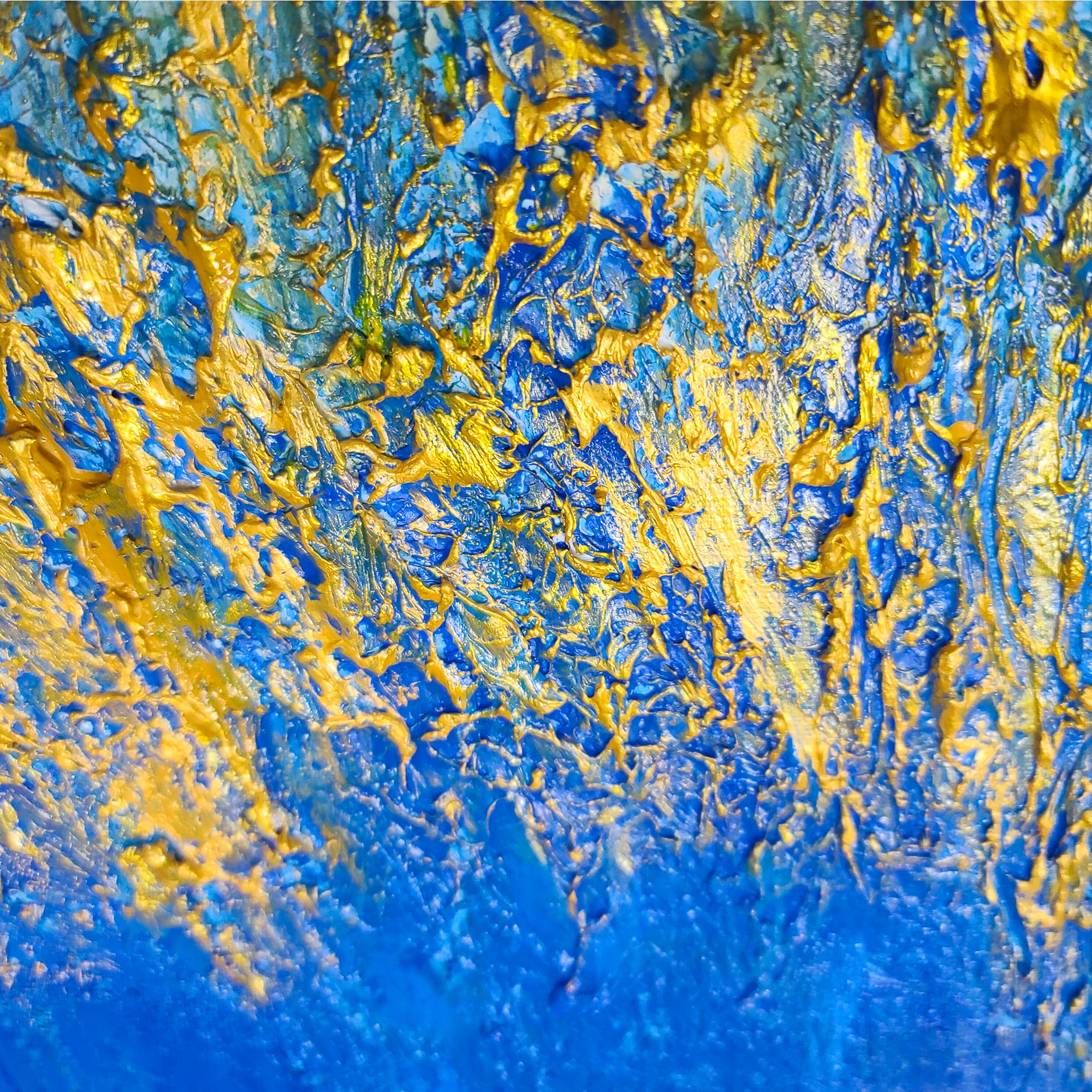
Every Lei-Kol original is built by hand over weeks in a sunlit Arizona studio. The paintings are not dashed off in an afternoon or generated by algorithm. They are constructed in thick, deliberate layers — each one a physical decision that shapes how light falls, how shadow pools, and how the finished piece commands a room.
The Studio Environment
Lei-Kol works from a dedicated studio in Arizona — a converted garage with north-facing windows that provide consistent, indirect natural light throughout the day. This is not accidental. North light is the gold standard for painters because it produces the most neutral, consistent illumination. Colors mixed under north light read true in any room they eventually hang in. Direct southern sun would overheat the acrylic as it cures and distort color perception. East or west windows create shifting light that makes it impossible to judge a painting's palette across a full workday.
The studio floor is a Jackson Pollock-level archaeology of the paintings that came before — layers of dried acrylic splatter and texture medium that map the history of every piece built here. Canvases lean against three walls at various stages of completion. The largest, a 48x60-inch stretcher bar frame, occupies the central easel — a heavy-duty H-frame that can handle canvases weighing 40 pounds or more when fully loaded with impasto. Smaller canvases rotate onto secondary easels as needed. A commercial-grade ventilation system runs during all active painting hours.
Lei-Kol paints standing. The physicality of heavy-texture work demands it. Building up impasto requires the kind of full-body movement — sweeping arm gestures, wrist articulation for ridge work, whole-hand manipulation of palette knives — that sitting at a desk easel cannot accommodate. Music is always on. The studio has a rhythm, and the paintings absorb it.
Materials & Mediums
Every material choice in the studio is made for permanence, texture, and archival quality. Lei-Kol works exclusively in professional-grade heavy-body acrylics — primarily Golden Heavy Body, Liquitex Professional, and Winsor & Newton Professional Acrylic. These are not the watery craft paints sold in two-ounce bottles at hobby stores. Heavy-body acrylics have the consistency of soft butter straight from the tube. They hold peaks, ridges, and knife marks exactly where they are placed. They do not slump, sag, or self-level.
The texture in a Lei-Kol painting comes from three sources: the paint itself, the mediums mixed into it, and the application technique. Golden Extra Heavy Gel (Matte) is the primary texture-building medium. Mixed directly into paint on the palette, it increases body without diluting color. For extreme peaks — the kind that cast centimeter-deep shadows — Lei-Kol uses Golden Molding Paste, which can be built to nearly any thickness without cracking, shrinking, or yellowing over time. Unlike oil paint, which can take months or years to fully cure and carries the risk of surface cracking in thick applications, high-quality acrylic mediums are chemically engineered to dry evenly at any practical thickness.
Canvases are heavy-duty cotton duck stretched over kiln-dried pine stretcher bars — gallery profile at 1.5 inches deep, which allows the painted edges to be displayed frameless. Before any paint touches the surface, every canvas receives three coats of professional-grade acrylic gesso, sanded between coats to a smooth — but not glass-smooth — finish. The slight tooth of the final gesso layer gives the heavy-body paint something to grip.
Palette knives are the primary tool. Brushes come in for base layers, blending, and fine edge work, but the signature Lei-Kol texture — those sweeping ridges, stippled peaks, and sculptural landforms — is applied with stainless steel palette knives ranging from two-inch trowels to fourteen-inch plastering blades. Each knife shape produces a different mark. A diamond-shaped knife creates sharp ridges. A wide rectangular trowel creates broad, wind-swept planes. A small teardrop knife creates concentrated stippling. The knife collection is large, and Lei-Kol knows exactly which tool produces which effect.
Building Impasto: Layer by Layer
If you have only ever painted with standard acrylics — or only seen flat paintings — the impasto process may seem mysterious. It is not technically mysterious. It is methodical, physical, and patient. What makes it rare is not difficulty but time. Most painters will not spend three weeks building a surface when they could finish three flat paintings in the same period. Lei-Kol makes the opposite choice: build one surface that will never be mistaken for anything but a genuine original.
The process begins with a composition wash. A thin, watery layer of acrylic establishes the broad color field — where the warm tones will live, where the cool tones will anchor, where the focal point will center. This wash dries in under an hour. The painting at this stage looks nothing like the finished product. It is a ghost: flat, tentative, under-committed.
Layer two introduces the first texture. Medium-heavy-body paint mixed with gel medium is applied with broad palette knives in sweeping, directional strokes. This is where the painting's physical architecture is established — the major ridges, the primary color-block contours, the structural skeleton that later, finer layers will elaborate. This layer dries for 24 hours. Rushing it would mean the next layer re-wets the surface and muddies the definition.
Layers three through six (or eight, or twelve — there is no fixed number) build progressively finer texture detail on top of the structural base. Each layer is applied with increasing specificity: smaller knives, tighter strokes, more deliberate color placement. Gold, copper, and metallic accents go in at the midpoint — they need the dark base layers beneath them to read as luminous, not flat. The exaggerated peaks — the centimeter-high ridges that catch raking light — are built with molding paste on palette knives, applied in a single pass, and left untouched to dry completely before anything goes near them. A ridge disturbed before curing is a ridge lost.
Between layers, Lei-Kol rotates the canvas. She views it from different angles, in different light conditions — morning north light, afternoon indirect, artificial gallery lighting at night. A painting that looks balanced from one angle may read as unbalanced from another. Texture that reads as dynamic in morning light may be invisible in flat overhead light. The rotation-and-review cycle happens at least once per layer, often more.
At any given time, there are typically three to five paintings in the studio at different stages of completion. While one cures, another gets worked. This is not a production line — each piece gets undivided attention during its active stage — but the curing time between layers makes batch-work the only practical approach. A single large piece might spend twenty total hours under active work spread across four weeks of calendar time. The paint is doing things during those in-between hours: curing, settling, reaching its final color value. You cannot rush acrylic cure time any more than you can rush concrete.
From Inspiration to Finished Piece
Inspiration for Lei-Kol comes from lived experience, not Pinterest boards. The volcanic landscapes of Hawaii — where she spent formative years — are the most obvious source. The layered blues of Maui's waterfalls, the black-and-red contrast of cooling lava against ocean, the gold of Pacific sunsets that burn for forty minutes after the sun drops below the horizon. These are not abstract concepts. They are memories translated into color and texture.
Travel feeds the palette. The bold street murals of San Francisco's Mission District. The honest, unpretentious texture of Chicago brick. The organized chaos of Seattle's Pike Place Market. Urban environments produce a different kind of painting than natural ones — tighter, more structured, more angular. Pieces like Bipolar and Graffiti come from city energy. Pieces like Maui and Waterfalls come from the islands. Both threads run through the catalog.
When a new piece begins, there is rarely a sketch. Lei-Kol works directly on canvas. The composition emerges from the first wash, guided by instinct and years of built visual vocabulary. This is not improvisation in the jazz sense — it is not random — but it is also not pre-planned. The painting reveals itself as it is built. By layer three, the direction is clear. By layer five, the title often presents itself. By the final layer, the piece has become what it was always going to be.
Emotional state matters. Paintings built during periods of intensity — and Lei-Kol does not shy away from this — carry a different charge than those built during periods of serenity. Bipolar, as the name suggests, was built across emotional extremes and reads as volatile and electric. Gray Day was built during a period of quiet contemplation and reads as meditative. Collectors who connect with a specific piece are often connecting with the emotional frequency it was built at, whether they know it consciously or not.
Why Heavy Texture Matters to Collectors
In an era where AI can generate any image in seconds and print-on-demand services can put that image on canvas for forty dollars, texture is the definitive signal of a handmade original. A flat print — no matter how high the resolution — has no physical dimension. It looks the same from every angle, in every light. A heavy-texture original is different at 8 a.m. than it is at 6 p.m. Morning light rakes across the ridges and casts long shadows. Evening light fills the valleys and softens the peaks. The painting is literally alive in the room in a way no reproduction can approach.
Texture is also honest. You cannot fake centimeter-deep impasto with a printer. You cannot mass-produce the physical evidence of an artist's hand — the specific pressure of a specific knife on a specific day. Every ridge, every stipple, every sweep is a record of a physical action made by a real person in real time. For collectors who value authenticity — and in the age of generative AI, that is increasingly all serious collectors — heavy texture is not a style preference. It is verification.
Beyond authenticity, texture creates presence. A flat painting fills wall space. A textured painting commands it. Guests stop. They lean in. They reach out. The dimensional surface invites interaction in a way a flat surface does not. This is not a small thing when you are spending real money on art for your home. You want the piece to work. You want it to start conversations. Heavy texture does that work for you, every day, without saying a word.
For investment-minded collectors, texture carries additional weight. Heavy-impasto paintings are harder to forge, easier to authenticate, and rarer in the market than flat paintings. Artists who commit to texture-heavy work are making a deliberate choice to trade volume for presence — fewer pieces, more substance per piece. Scarcity matters. So does distinctiveness. A Lei-Kol original is identifiable as a Lei-Kol original from across a room. That kind of visual signature is what separates artists whose work holds value from artists whose work is interchangeable.
Get in Touch
Questions About the Process?
Explore Related
More About Lei-Kol's Work
The Artist
Learn about Lei-Kol — her background, influences, and philosophy on art without gatekeepers.
Custom Commissions
Commission a one-of-a-kind painting built to your exact specifications by Lei-Kol.
Heavy Texture Acrylic Paintings
Explore the full catalog of dimensional, sculptural original paintings.
Original Art vs Prints
Why a real painting is fundamentally different from a reproduction — and why it matters.
Certificate of Authenticity
What comes with every Lei-Kol original and why provenance matters.
Art Gallery
Browse all available original paintings — each one-of-a-kind, each built by hand.