Painting study · Ink painting
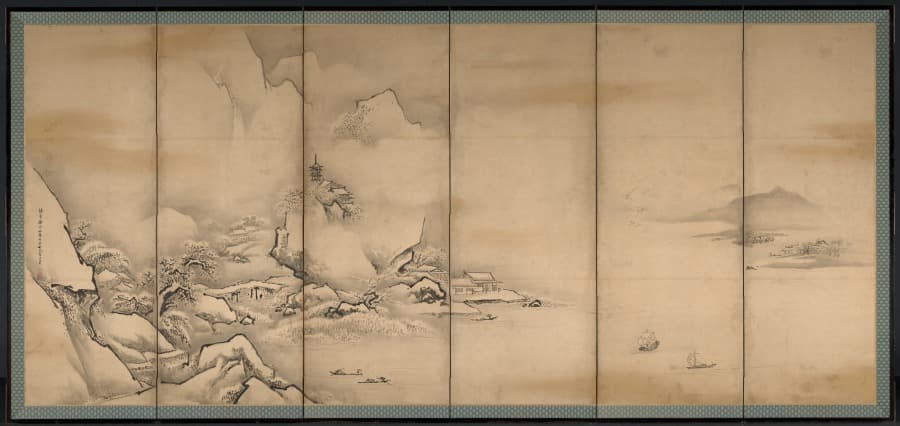
The Four Seasons1668 · Study 1992.394.2
Kano Tan’yū (Japanese, 1602–1674)
1668
Recorded as Six-panel folding screen, ink and slight color on paper, this horizontal work measures 381 × 174 cm using the museum’s image dimensions. Explore the museum’s context and compare the format with a wall of your choice.
Museum collection reference. This work is not offered for sale by Physical Art For Crypto. Museum attribution does not imply a partnership or endorsement.
Context from the museum
Tan'yū's skills were honed early within the regimen of the Kano family's painting studio. His grandfather, Eitoku (1543–1590) was the Momoyama period's most sought-after painter, a champion of colorful, large-scale painting compositions who worked for several of the country's most powerful leaders. When the young Tan'yū was summoned to Edo in 1617 by the shogun to become a member of the new capital's official painting studio, few opportunities to work on similarly ambitious projects existed. Yet by the end of his career, Tan'yū had supervised the execution and installation of linked mural painting compositions in several of Japan's most prestigious residences and castles. As an official court painter to the first shogun, Tokugawa Ieyasu (reigned 1603–5), and then his successors, Tan'yū appears to have successfully juggled his official duties with private activities as a teacher, as the era's leading connoisseur of classic Chinese and Japanese painting, and as a practicing artist. His surviving compositions as well as thousands of sketches far surpass the oeuvre of any of his contemporaries. While studio assistants surely contributed to his oeuvre, just as later imitators consciously confused his accomplishments, a clearer image of the painter has emerged in recent years that better conforms with his contemporary acclaim as recorded in seventeenth- and eighteenth-century documents. Tan'yū can now be seen as an artist adept in virtually all traditional ink painting subject matter, which he often presented in novel interpretations. Equally important are his rare screen (byōbu) compositions executed in a pure yamato-e manner with vivid mineral pigments on a gold-foil background. This pair of byōbu presents Tan'yū's more orthodox approach to academic ink painting methods embracing Chinese themes that had been interpreted by numerous Japanese ink painters over the centuries. Thus a typical view of residences and human activities set along the shores of an impressive river (or lake) is enlivened by the Japanese proclivity for including seasonal references. Proceeding from right to left, the viewer passes sequentially from spring to the snow-laden branches of winter. Tan'yū lends considerable atmospherics to the panorama in his use of misty cloud banks, frequently set off by sharp, darkened ink lines or whole areas of ink washes of variegated tonalities. The spring and summer views are particularly notable in this regard, as is the presence of the artist's signature on both byōbu, attesting to their completion in Tan'yū's sixty-seventh year (1668) — 50 years after he left Kyoto for the capital, and 30 years following his adoption of the artist name "Tan'yū" (in 1635). From 1622, when he began work on the mural paintings for Edo castle (the shogun's formal residence), through the completion of the painting cycle in 1636 for the Tokugawa family mausoleum in Nikkō to the north of Edo, Tan'yū's skills as head of an accomplished painting studio as well as a master painter found their most impressive expression in large-scale compositions. In 1638 he received the honorary Buddhist title Hōgen (Eye of the Law). It is intriguing therefore that relatively few independent byøbu paintings from the master's hand survive, particularly documented early works.
Museum description reproduced from its CC0 open-access record. Read the original catalog entry.
Read the dimensions before the image
The selected image measurement for The Four Seasons is 381 cm wide and 174 cm high, equivalent to approximately 150.0 × 68.5 inches. Dividing width by height gives a format ratio of 2.19:1. The rectangular bounding area is 6.63 square meters; it describes the measured footprint, not the amount of paint or the monetary value.
On an illustrative 300 cm wall, the recorded width occupies 127.0% of the span before adding a frame. That exceeds the example wall width, so a smaller reference wall would not reproduce the recorded scale. These are calculations by Physical Art For Crypto using museum measurements. They are not the museum’s display recommendations.
Questions to bring to your own collection
With The Four Seasons in view, identify one feature you can point to, then distinguish what the museum records from your personal response. Keep its medium, Six-panel folding screen, ink and slight color on paper, in your notes when comparing contemporary works.
- Which part of this horizontal composition catches your eye first?
- Would a 381 cm width still suit the space after allowing for furniture and a frame?
- What surface detail would you need to see in person or in a close photograph?
Explore physical scale
How large would this format feel on your wall?
Use this museum work’s recorded format as a reference. Adjust a blank wall and optional frame allowance to compare proportions. The museum painting is an educational reference and is not for sale here.
Calculation: outside width = recorded width + twice your frame allowance. This is a proportion study, not an installation assessment. It excludes furniture, hardware, load capacity, depth and delivery clearance. The display image may include margins absent from the recorded measurement.
Compare formats with the studio collection
These Lei-Kol works have the closest width-to-height ratios in the current catalog. This is a geometry comparison, not a claim of artistic similarity, equivalent value, or association with the museum artist.
| Painting | Width × height | Format ratio | USD catalog price |
|---|---|---|---|
| Bipolar | 60 × 48 in | 1.25:1 | $3,499 |
| Brick and Mortar | 60 × 48 in | 1.25:1 | $3,499 |
| Dominion | 60 × 48 in | 1.25:1 | $3,499 |
Availability and delivery costs must be confirmed for the individual order.
Related studies
1600s · Japan, Edo period (1615–1868)
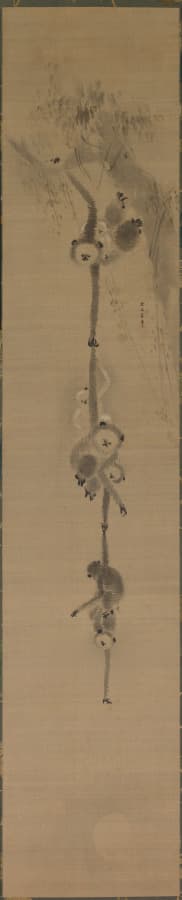
Gibbons Reaching for the Moon
Kano Tan’yū (Japanese, 1602–1674) · Hanging scroll; ink and light color on silk
1600s · Japan, Edo period (1615–1868)
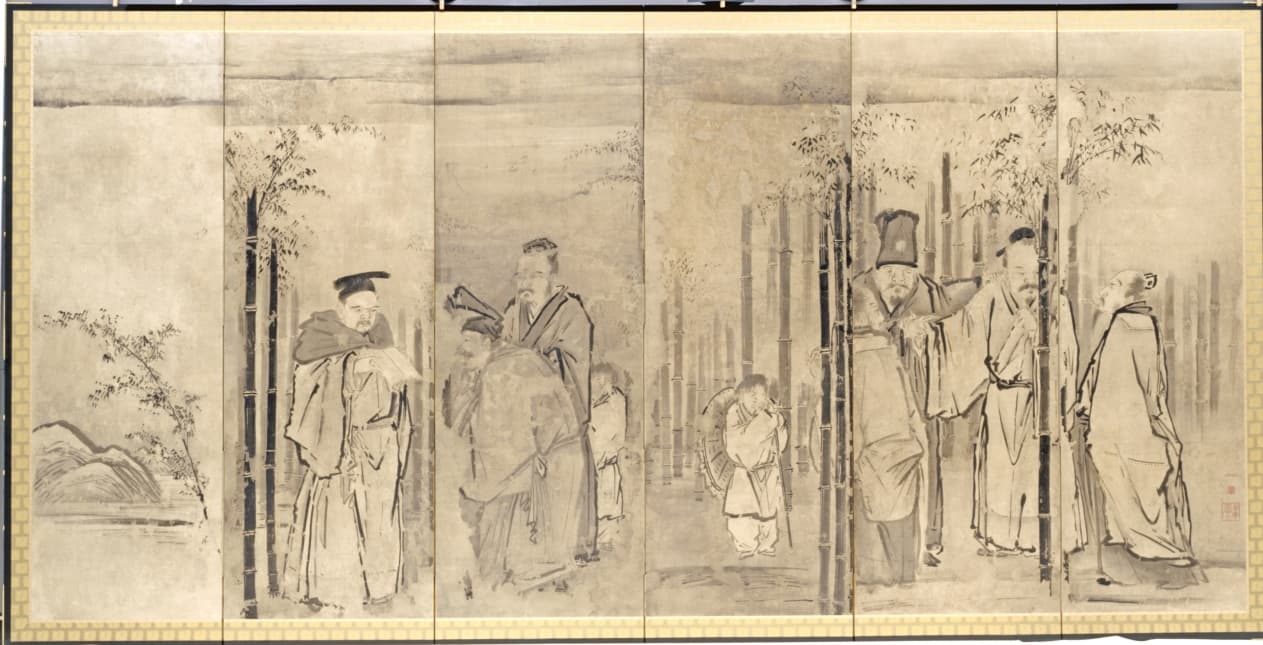
Seven Sages of the Bamboo Grove
Kano Tan’yū (Japanese, 1602–1674) · One of a pair of six-panel folding screens; ink on paper
1600s · Japan, Edo period (1615–1868)
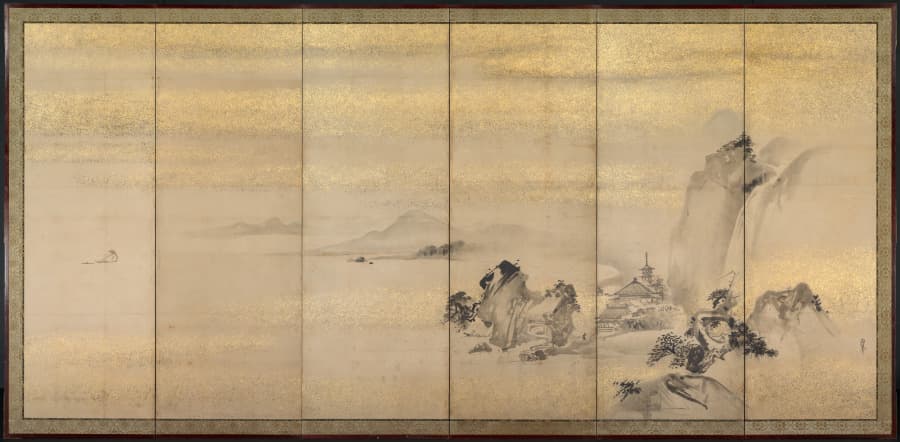
Summer and Winter Landscapes (one of a pair)
Kano Naonobu (Japanese, 1607–1650) · six-panel folding screen; ink on gold- and silver-decorated paper
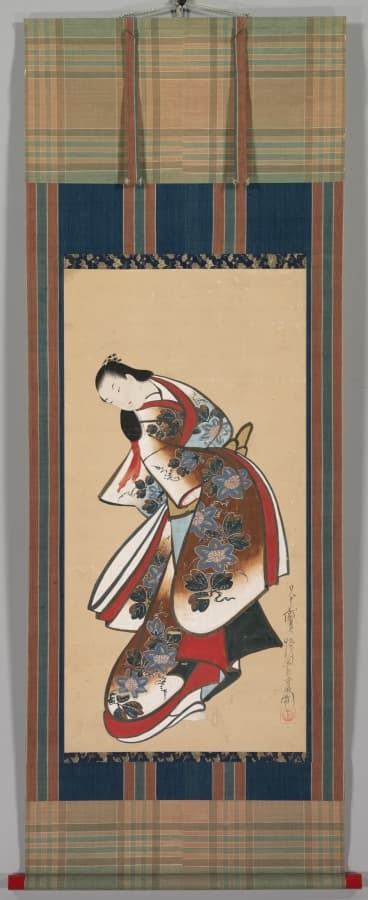
early 1700s · Japan, Edo period (1615–1868)
Courtesan
Kaigetsudō Doshin (Japanese, active 1711–1736) · hanging scroll; ink and color on paper
Ready to describe what you want in your own space?
Start an artwork inquiry ↗