Painting study · Ink painting
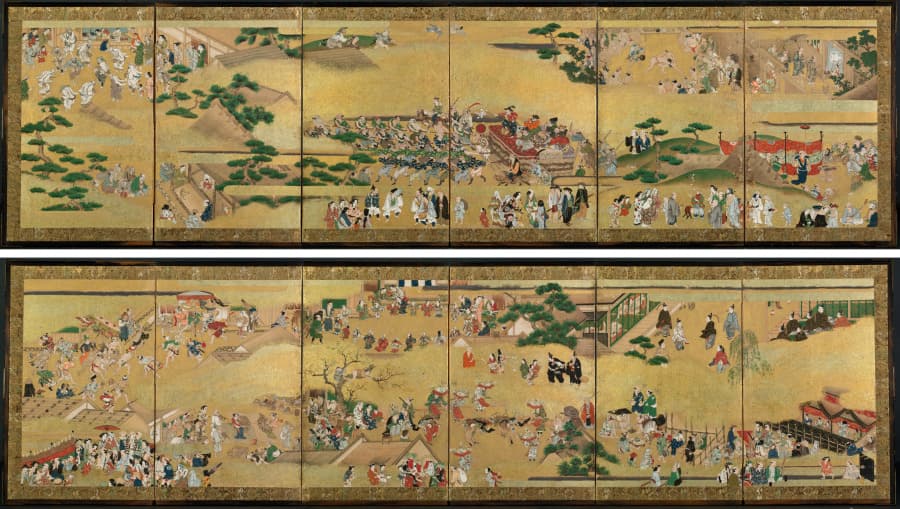
Festival Scenes1615–99 · Study 1985.279
Artist not recorded
1615–99
Recorded as pair of six-panel folding screens; ink, color, gold, and gold leaf on paper, this horizontal work measures 208.9 × 51.1 cm using the museum’s overall dimensions. Explore the museum’s context and compare the format with a wall of your choice.
Museum collection reference. This work is not offered for sale by Physical Art For Crypto. Museum attribution does not imply a partnership or endorsement.
Context from the museum
Much smaller in size than standard Japanese folding screens, this lively pair depicts all manner of entertainments. Although at first they seem to show an ongoing festival, closer examination reveals that the screens comprise a series of isolated scenes from disparate occasions. In one screen, crowds gather around a bout of sumo wrestling as well as juggling and balancing acts. Elsewhere, teams of men pull a float bearing musicians costumed in foreign dress. There is also a dance circle with drums, a performing monkey, and a party of falconers. In the other screen, male courtiers observe a game of kickball played by noblemen, while their female counterparts watch from behind bamboo curtains. Others enjoy a theater performance. A children’s dance circle and a dance performance with ladies sporting elaborate headgear occupy the center of the screen. A group wielding huge parasols at the upper left of the screen reenacts episodes from legend, as still other performances, including dancing dogs, entertain the crowds below.
Museum description reproduced from its CC0 open-access record. Read the original catalog entry.
Read the dimensions before the image
The selected overall measurement for Festival Scenes is 208.9 cm wide and 51.1 cm high, equivalent to approximately 82.2 × 20.1 inches. Dividing width by height gives a format ratio of 4.09:1. The rectangular bounding area is 1.07 square meters; it describes the measured footprint, not the amount of paint or the monetary value.
On an illustrative 300 cm wall, the recorded width occupies 69.6% of the span before adding a frame. A centered placement leaves approximately 45.5 cm on each side before adding a frame. These are calculations by Physical Art For Crypto using museum measurements. They are not the museum’s display recommendations.
Questions to bring to your own collection
With Festival Scenes in view, identify one feature you can point to, then distinguish what the museum records from your personal response. Keep its medium, pair of six-panel folding screens; ink, color, gold, and gold leaf on paper, in your notes when comparing contemporary works.
- Which part of this horizontal composition catches your eye first?
- Would a 208.9 cm width still suit the space after allowing for furniture and a frame?
- What surface detail would you need to see in person or in a close photograph?
Explore physical scale
How large would this format feel on your wall?
Use this museum work’s recorded format as a reference. Adjust a blank wall and optional frame allowance to compare proportions. The museum painting is an educational reference and is not for sale here.
Calculation: outside width = recorded width + twice your frame allowance. This is a proportion study, not an installation assessment. It excludes furniture, hardware, load capacity, depth and delivery clearance. The display image may include margins absent from the recorded measurement.
Compare formats with the studio collection
These Lei-Kol works have the closest width-to-height ratios in the current catalog. This is a geometry comparison, not a claim of artistic similarity, equivalent value, or association with the museum artist.
| Painting | Width × height | Format ratio | USD catalog price |
|---|---|---|---|
| Bipolar | 60 × 48 in | 1.25:1 | $3,499 |
| Brick and Mortar | 60 × 48 in | 1.25:1 | $3,499 |
| Dominion | 60 × 48 in | 1.25:1 | $3,499 |
Availability and delivery costs must be confirmed for the individual order.
Related studies
1600s · Japan, Edo period (1615–1868)
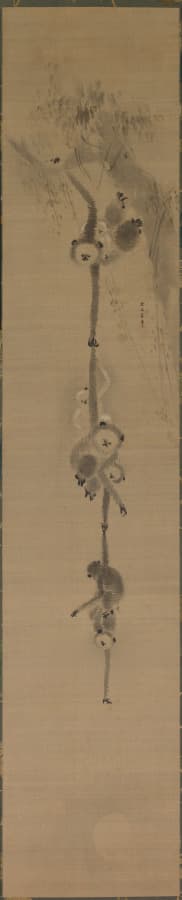
Gibbons Reaching for the Moon
Kano Tan’yū (Japanese, 1602–1674) · Hanging scroll; ink and light color on silk
1600s · Japan, Edo period (1615–1868)
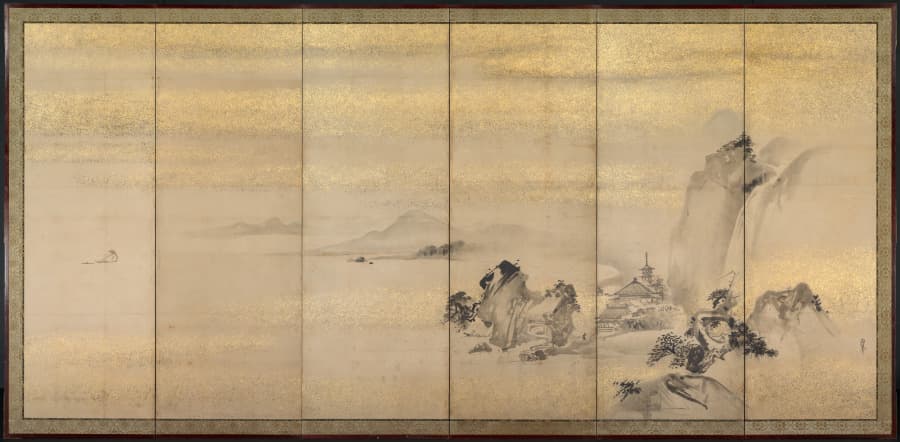
Summer and Winter Landscapes (one of a pair)
Kano Naonobu (Japanese, 1607–1650) · six-panel folding screen; ink on gold- and silver-decorated paper
early 1700s · Japan, Edo period (1615–1868)
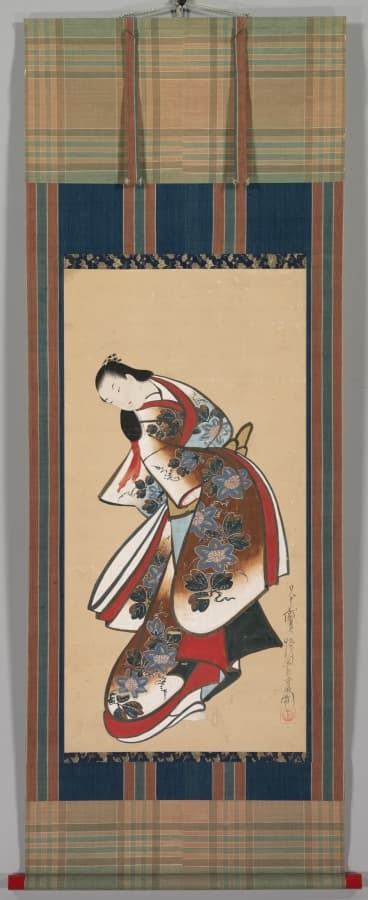
Courtesan
Kaigetsudō Doshin (Japanese, active 1711–1736) · hanging scroll; ink and color on paper
late 1700s · Japan, Edo period (1615–1868)
Scenes from the Tale of Genji
Artist not recorded · Pair of six-panel folding screens; ink, color, and gold on gilded paper
Ready to describe what you want in your own space?
Start an artwork inquiry ↗