Painting study · Ink painting
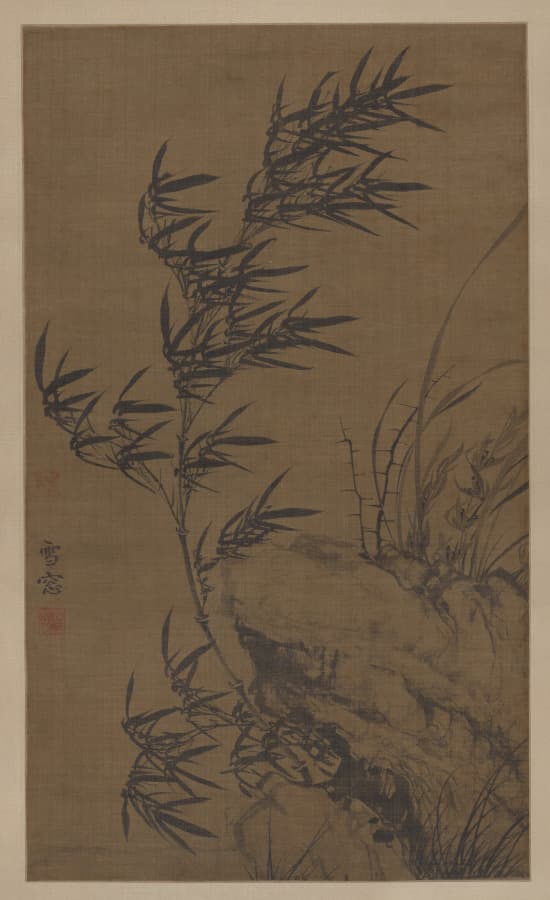
Bamboo in the Wind1300s · Study 1953.246
Puming (Xuechuang) (Chinese, active before 1274–after 1329)
1300s
Recorded as Hanging scroll; ink on silk, this vertical work measures 45.7 × 77.6 cm using the museum’s painting dimensions. Explore the museum’s context and compare the format with a wall of your choice.
Museum collection reference. This work is not offered for sale by Physical Art For Crypto. Museum attribution does not imply a partnership or endorsement.
Context from the museum
Bamboo is an evergreen plant that does not break under the weight of snow or the force of the wind, and thus became a favorite motif in literati painting and Chan Buddhism as a metaphor for the virtue of not yielding to worldly temptations. Xuechuang, also known as monk Puming, was a native of Songjiang, near Shanghai, who spent his life as a monk in Suzhou. In 1338, he presided over Yunyan temple on Tiger Hill. Here, he masterfully depicts a bamboo gently bent in a subtle breeze. Puming’s paintings were revered in Japan and Korea.
Museum description reproduced from its CC0 open-access record. Read the original catalog entry.
A detail to notice
Bamboo, pine, and plum, often referred to as the "three friends of winter," are popular motifs in Chinese literati art.
Observation supplied by the Cleveland Museum of Art.
Read the dimensions before the image
The selected painting measurement for Bamboo in the Wind is 45.7 cm wide and 77.6 cm high, equivalent to approximately 18.0 × 30.6 inches. Dividing width by height gives a format ratio of 0.59:1. The rectangular bounding area is 0.35 square meters; it describes the measured footprint, not the amount of paint or the monetary value.
On an illustrative 300 cm wall, the recorded width occupies 15.2% of the span before adding a frame. A centered placement leaves approximately 127.2 cm on each side before adding a frame. These are calculations by Physical Art For Crypto using museum measurements. They are not the museum’s display recommendations.
Questions to bring to your own collection
With Bamboo in the Wind in view, identify one feature you can point to, then distinguish what the museum records from your personal response. Keep its medium, Hanging scroll; ink on silk, in your notes when comparing contemporary works.
- Which part of this vertical composition catches your eye first?
- Would a 45.7 cm width still suit the space after allowing for furniture and a frame?
- What surface detail would you need to see in person or in a close photograph?
Explore physical scale
How large would this format feel on your wall?
Use this museum work’s recorded format as a reference. Adjust a blank wall and optional frame allowance to compare proportions. The museum painting is an educational reference and is not for sale here.
Calculation: outside width = recorded width + twice your frame allowance. This is a proportion study, not an installation assessment. It excludes furniture, hardware, load capacity, depth and delivery clearance. The display image may include margins absent from the recorded measurement.
Compare formats with the studio collection
These Lei-Kol works have the closest width-to-height ratios in the current catalog. This is a geometry comparison, not a claim of artistic similarity, equivalent value, or association with the museum artist.
| Painting | Width × height | Format ratio | USD catalog price |
|---|---|---|---|
| Graffiti | 30 × 48 in | 0.63:1 | $2,199 |
| Gray Day | 24 × 36 in | 0.67:1 | $1,199 |
| Waterfalls | 24 × 36 in | 0.67:1 | $999 |
Availability and delivery costs must be confirmed for the individual order.
Related studies

1360 · China, Yuan dynasty (1271–1368)
Leisure Enough to Spare
Yao Tingmei (Chinese, active mid-1300s) · handscroll; ink on paper

c. 1320s · China, Yuan dynasty (1271–1368)
Three Horses and Four Grooms
Ren Renfa (Chinese, 1254–1328) · handscroll; ink and color on silk

late 1200s–early 1300s · China, Yuan dynasty (1271–1368)
The Lantern Night Excursion of Zhong Kui
Yan Hui (Chinese, active 1270–1310) · handscroll; ink and slight color on silk

1271–1368 · China, Yuan dynasty (1271–1368)
Bamboo, Rocks, and Lonely Orchids
Zhao Mengfu (Chinese, 1254–1322) · Handscroll; ink on paper
Ready to describe what you want in your own space?
Start an artwork inquiry ↗